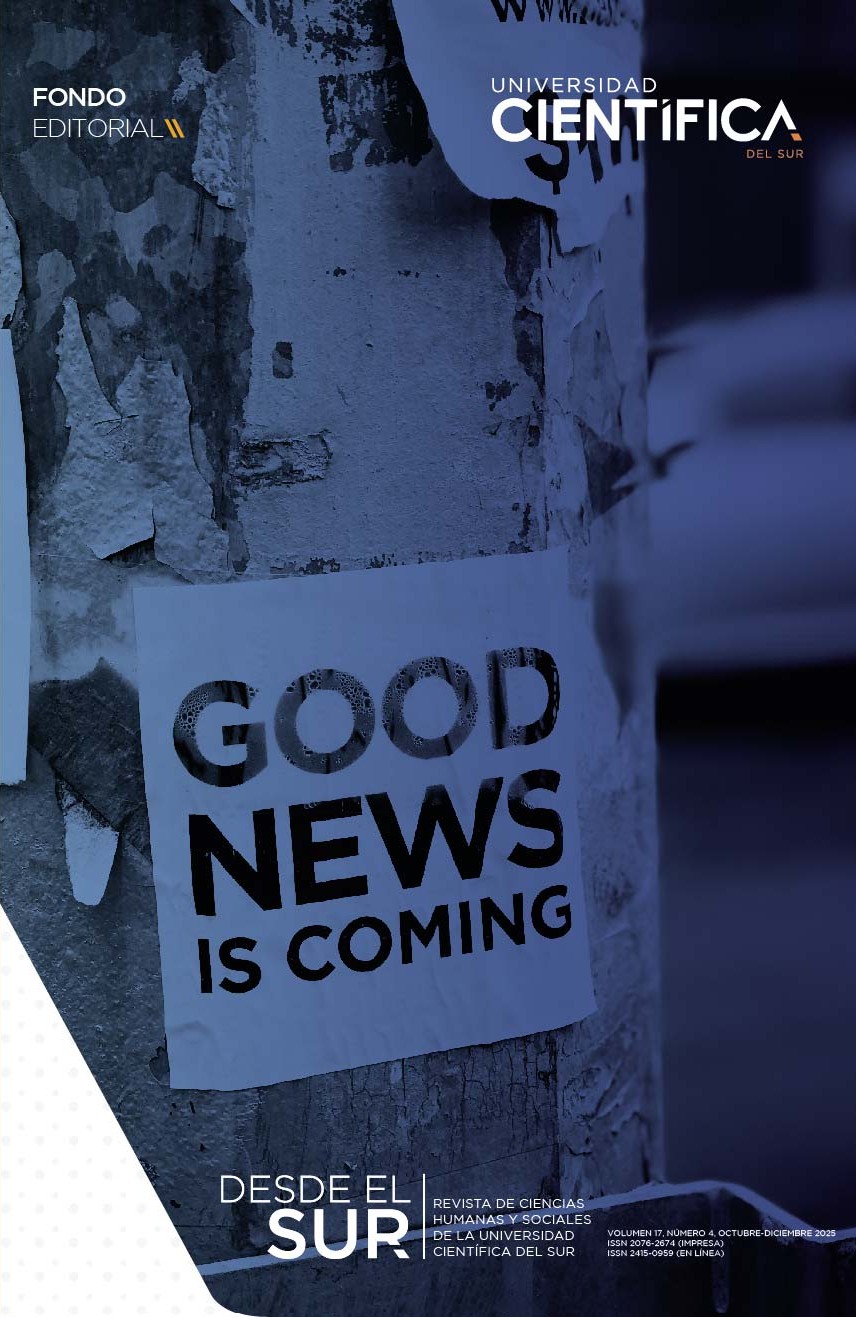
Fake news, disinformation, and media literacy in Ibero-America: A necessary debate
DOI:
https://doi.org/10.21142/DES-1704-2025-0079Keywords:
Media literacy, information literacy, disinformation, fake news, Ibero-AmericaAbstract
Disinformation has become a critical problem in contemporary societies, threatening democratic processes, public health, and social cohesion. In Ibero-America, the spread of fake news and deceptive content has gained prominence over the past decade, driven by the massive penetration of social networks and messaging apps. This article presents a review of scientific literature on fake news and disinformation in the Ibero-American context, with emphasis on the fundamental role of media, information, and digital literacy for future generations. It addresses the concepts of fake news and disinformation, their documented social impacts, and the responses developed by academia and public policy. The review highlights how media and information literacy is emerging as a key strategy —complementing legal and technological measures— to strengthen critical thinking and citizen resilience against disinformation. Likewise, it explores media education initiatives in Ibero-America, including educational programs, fact-checking projects, and recent public policies, revealing achievements and challenges. The literature suggests that integrating media literacy throughout formal education is essential to forge critical and engaged digital citizens. Finally, future perspectives in the fight against disinformation are discussed, underscoring the importance of multisector collaboration involving governments, media, digital platforms, educational institutions, and civil society in building a more truthful and inclusive information culture.
Downloads
References
Aguaded, I., & Romero-Rodríguez, L. M. (2015). Mediamorfosis y desinformación en la infoesfera: Alfabetización mediática, digital e informacional ante los cambios de hábitos de consumo informativo. Education in the Knowledge Society, 16(1), 44–57. https://doi.org/10.14201/eks20151614457
Allcott, H., & Gentzkow, M. (2017). Social media and fake news in the 2016 election. Journal of Economic Perspectives, 31(2), 211–236. https://doi.org/10.1257/jep.31.2.211
Amado, A. (2022). El ecosistema de la desinformación en América Latina. Siglo XXI Editores.
Badillo, Á. (2019). Comunicación, geopolítica y poder en América Latina. Editorial UOC.
Becerra, M. (2014). De la concentración a la convergencia: Políticas de medios en Argentina y América Latina. Paidós.
Bennett, W. L., & Livingston, S. (2018). The disinformation order: Disruptive communication and the decline of democratic institutions. European Journal of Communication, 33(2), 122–139. https://doi.org/10.1177/0267323118760317
Berger, P. L., & Luckmann, T. (1966). The social construction of reality. Anchor Books.
Carrillo, N., & Montagut, M. (2021). Tackling online disinformation through media literacy in Spain: The project “Que no te la cuelen”. Catalan Journal of Communication & Cultural Studies, 13(1), 149–157. https://doi.org/10.1386/cjcs_00044_7
Chaves, M., & Braga, C. (2019). Fake news e eleições no Brasil: Desinformação política no WhatsApp. Revista Brasileira de Política Internacional, 62(2), e012.
European Commission. (2018). Action Plan Against Disinformation. https://eeas.europa.eu/headquarters/headquarters-homepage/54866/action-plan-against-disinformation_en
Ferrés, J., & Piscitelli, A. (2012). La competencia mediática: propuesta articulada de dimensiones e indicadores. Comunicar, 19(38), 75–82. https://doi.org/10.3916/C38-2012-02-08
Galarza-Molina, S. (2021). ¿Quién cree las fake news? Análisis de la relación entre consumo de medios y la percepción de veracidad de noticias falsas sobre la enfermedad COVID-19 en Nuevo León, México. AdComunica, 21, 265-285. http://dx.doi.org/10.6035/2174-0992.2021.21.13
Hernández-García, I., & Giménez, E. (2021). Infodemia y salud pública: Desinformación durante la pandemia de COVID-19. Gaceta Sanitaria, 35(6), 598–602. https://doi.org/10.1016/j.gaceta.2021.04.003
Hernández, A., Martínez, S., & Del Valle, C. (2022). Regulación de la desinformación y riesgos para la libertad de expresión en Iberoamérica. Communication & Society, 35(4), 341–358. https://doi.org/10.15581/003.35.4.341-358
Lotero-Echeverri, G., Romero-Rodríguez, L. M., & Pérez-Rodríguez, M. A. (2018). Fact-checking vs. fake news: Periodismo de confirmación como recurso de la competencia mediática contra la desinformación. index.comunicación, 8(2), 295–316.
Palau-Sampio, D. (2018). Fact-checking and scrutiny of power: Supervision of public discourses in new media platforms from Latin America. Communication & Society, 31(3), 347–365. https://doi.org/10.15581/003.31.3.347-363
Pérez Tornero, J. M., Tayie, S. S., Tejedor, S., & Pulido, C. (2018). How to confront fake news through news literacy? State of the art. Doxa Comunicación, 26, 211–235. https://doi.org/10.31921/doxacom.n26a10
Rodrigo-Alsina, M., & Cerqueira, L. (2019). Desinformación y polarización en el proceso independentista catalán. Profesional de la Información, 28(5), e280501. https://doi.org/10.3145/epi.2019.sep.01
Rodríguez-Hidalgo, C., Rivera-Rogel, D., & Romero-Rodríguez, L. M. (2020). Information quality in Latin American digital native media: Analysis based on structured dimensions and indicators. Media and Communication, 8(2), 138-152. https://doi.org/10.17645/mac.v8i2.2657
Romero-Rodríguez, L.M., De-Casas-Moreno, P., & Caldeiro-Pedreira, M.C. (2018). Desinformación e infoxicación en las cuartas pantallas. En I. Aguaded y Romero-Rodríguez, L.M. (Eds.), Competencias mediáticas en medios digitales emergentes (pp. 73-92). Comunicación Social Ediciones.
Romero-Rodríguez, L. M., Valle Razo, A. L., & Castillo-Abdul, B. (2021). Fake news de humor y sátira y actitudes hacia la política: Análisis comparativo del realismo percibido y los sentimientos de eficacia, alienación y cinismo en estudiantes de comunicación. OBETS: Revista de Ciencias Sociales, 16(2), 465–480. https://doi.org/10.14198/OBETS2021.16.2.15
Sádaba, C., & Salaverría, R. (2023). Combatir la desinformación con alfabetización mediática: análisis de las tendencias en la Unión Europea. Revista Latina de Comunicación Social, 81, 1–18. https://doi.org/10.4185/RLCS-2023-1552
Searle, J. R. (1995). The construction of social reality. Free Press.
Soto, R. (2020). Desinformación y discurso político en las elecciones generales de 2019 en España. Profesional de la Información, 29(5), e290513. https://doi.org/10.3145/epi.2020.sep.13
Tejedor, S.; Cervi, L.; Romero-Rodríguez, L.M.; Vick, S. Integrating Artificial Intelligence and Big Data in Spanish Journalism Education: A Curricular Analysis. Journal. Media 2024, 5, 1607-1623. https://doi.org/10.3390/journalmedia5040100
Tejedor, S. (2025). Inteligencia Artificial y periodismo. Cómo formar a los profesionales del futuro. Barcelona, UOC.
Verón-Lassa, J. J., Sancho-Ligorred, B., & Pérez-Zapater, B. (2023). Alfabetización mediática contra la desinformación: análisis de 25 iniciativas promovidas en España. Doxa Comunicación, 41, 113–134. https://doi.org/10.31921/doxacom.n41a2899
Valverde-Berrocoso, J., González-Fernández, A., & Acevedo-Borrega, J. (2022). Desinformación y multialfabetización: Una revisión sistemática de la literatura. Comunicar, 30(70), 97–110. https://doi.org/10.3916/C70-2022-08
Watzlawick, P. (1976). How real is real? Confusion, disinformation, communication. Vintage Books.
World Health Organization. (2020). Managing the COVID-19 infodemic: Promoting healthy behaviours and mitigating misinformation. WHO.
Downloads
Published
Issue
Section
License

Esta obra está bajo una licencia http://creativecommons.org/licenses/by-nc-sa/4.0/